Cortisol is supposed to spike in the morning and fall all day. Food and caffeine decide how cleanly that happens, and most people spend their first hour awake working against the curve.
Thirty to forty five minutes after you open your eyes, cortisol reaches the highest point it will hit all day. This is the cortisol awakening response, and it is not a malfunction. It mobilises glucose, raises blood pressure, sharpens attention and gets you vertical.
Jens Pruessner and colleagues at Trier established the pattern in 1997, sampling saliva at intervals in the first hour after waking across healthy adults. Free cortisol rose by roughly fifty to seventy five percent above the value at waking, peaked, then declined. Repeat measurements on separate days gave the same curve in the same person, which is why the response is used as a marker of adrenal reactivity rather than a one-off reading.
So the peak is already coming. The question is what you stack on top of it, and how much of that stacking is a choice about breakfast.

Three routes from your plate
to your adrenal glands
Cortisol comes out of a chain. The hypothalamus releases CRH, the pituitary answers with ACTH, and the adrenal cortex produces cortisol. That is the HPA axis, and it takes instructions from more than your workload.
The first route is blood glucose. Cortisol is a counter-regulatory hormone, which means one of its jobs is to defend blood sugar when it falls. A large fast-absorbing carbohydrate load raises glucose quickly, insulin overshoots, glucose drops below where it started, and the body treats the dip as a metabolic emergency. Cortisol and adrenaline come out to raise it again. You feel that as the eleven o'clock jitter followed by the need for something sweet.
The second is caffeine, which blocks adenosine receptors. Adenosine restrains ACTH release, so removing that brake raises cortisol directly rather than by making you feel busier. Coffee acts on the same axis your morning peak is already running.
The third is the gut, and it is the least settled of the three. Gut bacteria produce short-chain fatty acids and neuroactive metabolites, communicate with the brain through the vagus nerve and immune signalling, and shape how reactive the HPA axis is. Germ-free mice show exaggerated cortisol responses to restraint stress that normalise when specific bacteria are reintroduced. In humans the evidence is thinner and mostly comes from small probiotic trials.

What the caffeine data
actually shows
William Lovallo's group at the University of Oklahoma Health Sciences Center ran the studies most often cited on this. In their 2005 work in Psychosomatic Medicine they gave healthy habitual coffee drinkers caffeine at doses equivalent to roughly two to three cups, spread across the waking day, and sampled cortisol against placebo. Cortisol rose about thirty percent above placebo. Repeated dosing across the day produced partial tolerance, so the later doses moved cortisol less than the first, and tolerance was incomplete even in people who drink coffee every day.
The number circulating on social media is thirty to sixty percent within an hour on an empty stomach. Thirty is defensible. Sixty sits at the outer edge of the highest doses tested, and the empty stomach part was not the variable these studies manipulated. Food slows caffeine absorption and blunts the peak plasma concentration, which makes the mechanism plausible. Nobody has run the trial cleanly.
The practical point survives the correction. A double espresso taken minutes after waking lands on a peak that was going to happen anyway, and the two effects add. Wait ninety minutes and you are adding to a curve on its way down.
Two further findings are worth having in your head. Magnesium: Klaus Held and colleagues gave oral magnesium to twelve elderly men in 2002 and saw increased slow-wave sleep alongside reduced evening ACTH and cortisol. Twelve men, one age group, no replication at scale. Treat the direction as promising and the effect size as unknown. Glycine: Yamadera and colleagues gave three grams before bed to small samples in the mid 2000s and found faster sleep onset and better subjective quality, with a plausible mechanism through a fall in core body temperature. Also small.
Probiotics: Michael Messaoudi's team gave a Lactobacillus and Bifidobacterium formulation to fifty five volunteers for thirty days in 2011 and measured lower urinary free cortisol alongside reduced psychological distress scores. It was randomised and placebo-controlled, which puts it a tier above the magnesium work. One formulation, one month, one sample. It does not license the claim that fermented food fixes your stress axis.
None of this is about lowering cortisol as far as possible. Flat cortisol is a marker of burnout, not health. What you want is a steep morning peak and a clean decline into the evening, and diet mostly affects the second half of that shape.

“The coffee is the least interesting part of this. People eat in a way that keeps requiring a glucose rescue every three hours, then attribute the resulting agitation to their workload. Change the breakfast and a surprising amount of what people call stress goes quiet.”

Five changes, in order
of how much they matter
Delay caffeine 90 to 120 minutes
Let the awakening response finish before you add to it. The secondary benefit is that adenosine has more time to clear, so you get the alertness without borrowing it from the afternoon. If you train early, take the caffeine before the session and accept the trade. Performance is a real reason to move it.
Put protein in front of the carbohydrate
Thirty to forty grams of protein at breakfast blunts the glucose excursion and removes the reactive dip that recruits cortisol two hours later. Eating protein and fibre before the starch in a mixed meal lowers the glucose peak measurably. The effect is small per meal and compounds across a day.
Stop eating two to three hours before bed
Digestion raises core temperature and metabolic rate at the point when both need to fall. Late large meals delay sleep onset and shift sleep architecture. The direct evidence that late eating raises overnight cortisol specifically is weaker than the evidence that it degrades sleep, and degraded sleep raises next-day cortisol reliably.
Take the alcohol out of the sleep window
Alcohol shortens sleep onset, then fragments the second half of the night, suppresses REM and raises cortisol during the hours it should be at its lowest. This is the single largest self-inflicted disruption of the overnight cortisol curve available to most people, and it is more consequential than the timing of your coffee.
Feed the microbiome and be patient with it
Fermented foods and thirty grams of fibre a day are the two interventions with the best safety and cost profile, and the mechanism through short-chain fatty acids and vagal signalling is credible. The human cortisol evidence is early. Do it because gut health is worth having, and treat any stress benefit as a bonus you cannot yet quantify.
A 30-second decision rule
- Do you drink caffeine within thirty minutes of waking, most days?
- Is your first meal mostly fast carbohydrate, or nothing at all until midday?
- Do you eat a large meal or drink alcohol inside three hours of going to bed?

We sell magnesium and glycine.
Here is when not to buy them.
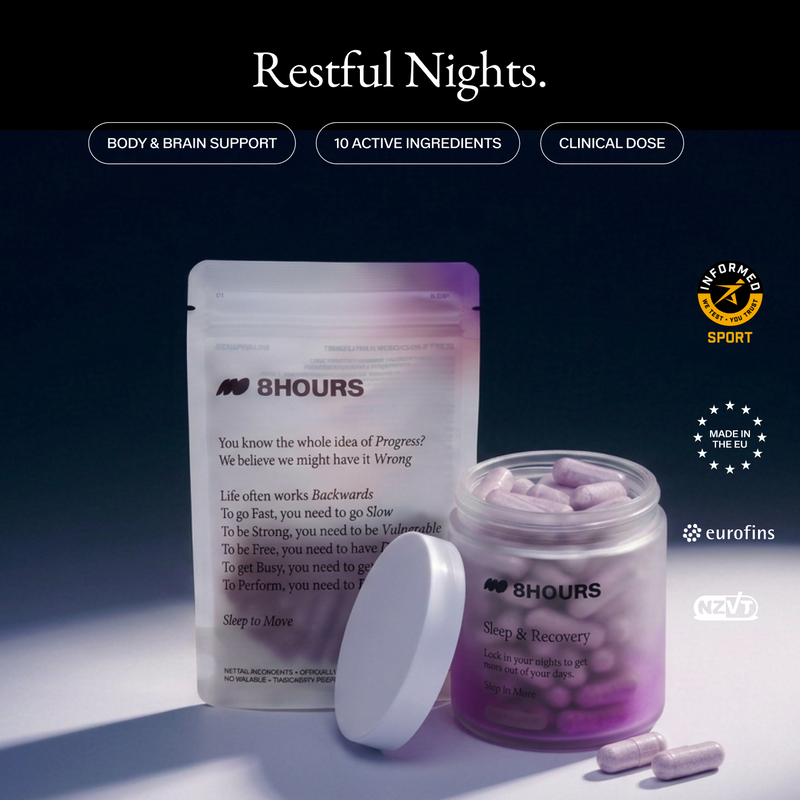
8hours Sleep & Recovery contains both, and we are confident in the formulation. What they do is support the quality and consolidation of sleep you have actually scheduled. Neither one lowers cortisol on its own, and the studies behind them are small enough that we will not pretend otherwise in an advert.
If you drink four coffees a day, the last one at five, do not buy our capsules. Move the coffee. If you eat dinner at eleven and open a bottle of wine with it, do not buy our capsules. Move the dinner. If you sleep five hours because of your calendar, no supplement in the world touches the problem, and ours will only improve the texture of five hours.
Items one to four of the protocol are free, and they are the ones with the strongest evidence behind them. We come in at the margin after those are handled. That is the whole pitch, and it is the accurate one.

Your cortisol curve is going to peak this morning whether you help it or not. The only decision is whether you double it before breakfast.
Send this to that friend who chugs a double espresso 1.45 seconds after waking up.
- Lovallo, W.R., Whitsett, T.L., al'Absi, M., Sung, B.H., Vincent, A.S. & Wilson, M.F. (2005). Caffeine stimulation of cortisol secretion across the waking hours in relation to caffeine intake levels. Psychosomatic Medicine, 67(5).
- Pruessner, J.C., Wolf, O.T., Hellhammer, D.H. et al. (1997). Free cortisol levels after awakening: a reliable biological marker for the assessment of adrenocortical activity. Life Sciences, 61(26).
- Held, K., Antonijevic, I.A., Kunzel, H. et al. (2002). Oral Mg2+ supplementation reverses age-related neuroendocrine and sleep EEG changes in humans. Pharmacopsychiatry, 35(4).
- Messaoudi, M., Lalonde, R., Violle, N. et al. (2011). Assessment of psychotropic-like properties of a probiotic formulation in rats and human subjects. British Journal of Nutrition, 105(5).