Adult ADHD diagnoses and stimulant prescriptions have climbed steeply across Europe and the US. The sleep half of the picture almost never comes up in the appointment, and it runs in both directions.
Restrict a child's sleep by one hour a night for five nights and their teachers, who know nothing about the study, rate them as more restless, more impulsive and more emotionally volatile. Reza Gruber's group in Montreal ran that experiment in 2012 with thirty four healthy children aged seven to eleven, in a crossover design where each child served as their own control.
The behavioural change showed up on a standard rating scale. It is the same scale used to screen for ADHD.
That is one direction. The other is that people with ADHD sleep badly at a rate far above the general population, and the medication that treats their attention can make the sleep worse. Both things are true at once, which is what makes this hard to think about clearly.

Sleep loss produces the
diagnostic criteria
Inattention, poor working memory, irritability, restlessness and impaired impulse control are the core of an ADHD assessment. They are also the reliable output of chronic partial sleep restriction in people with no attention disorder at all. The symptom list does not distinguish causes, and the questionnaire cannot ask your prefrontal cortex how much sleep it got last year.
The clearest demonstration comes from the surgical literature. Ronald Chervin and colleagues at Michigan followed children having their tonsils and adenoids removed for suspected sleep-disordered breathing. A substantial share of those who met criteria for ADHD before surgery no longer met them a year afterwards. Nobody treated their attention. They treated their breathing during sleep.
The reverse direction is just as well established. Sandra Kooij's group in Amsterdam has spent two decades documenting circadian delay in adult ADHD. Marije van Veen and colleagues published the sharpest version in Biological Psychiatry in 2010: forty adults with ADHD and chronic sleep-onset insomnia, compared against controls, with melatonin onset measured directly in dim light rather than inferred from a questionnaire. Around seventy eight percent of the ADHD group showed a delayed melatonin rhythm, averaging about ninety minutes later than controls.
Forty patients and twelve controls. Small, and the sample was selected for insomnia, so the percentage cannot be read across to everyone with ADHD. What survives is the mechanism: a body clock running late, biologically rather than behaviourally. Telling that person to go to bed earlier asks them to fall asleep before their own melatonin has been released.

What stimulants do to
the night that follows
Katherine Kidwell and colleagues at Nebraska pooled nine studies of stimulant medication and sleep in children and adolescents in Pediatrics in 2015. Three findings came out consistently. Sleep onset took longer, sleep efficiency fell, and total sleep duration shortened. Later doses and higher doses produced larger effects.
Methylphenidate has a short half-life, in the region of two to three hours, though extended-release formulations are engineered to hold plasma levels for eight to twelve. Lisdexamfetamine runs longer still. A dose at three in the afternoon is therefore not a spent dose at eleven at night, and the arousal system it acts on is the one that has to stand down for sleep to begin.
Two corrections to figures in circulation. The claim that up to eighty percent of people with ADHD have clinically significant sleep disturbance is widely repeated and roughly consistent with the literature on children, but the exact number depends heavily on how disturbance is defined and who is sampled. Take it as a strong pattern rather than a measured constant.
We also could not verify a 2020 Lancet Psychiatry paper by Cortese carrying these specific figures. Samuele Cortese has published extensively on ADHD, sleep and medication, including a 2009 meta-analysis of sleep in children with ADHD, and the direction of his work supports the claims above. We have cited what we can check.
None of this means adult ADHD is really just tiredness. It means sleep is a confound in the assessment and a lever in the treatment, and almost nobody is measuring it before writing the prescription.

“A titration appointment measures symptoms and dose. It almost never records what time the patient fell asleep for the last fortnight. We are adjusting a stimulant against an outcome that is partly determined by a variable nobody wrote down.”

Five things to do, none of
which is stopping your meds
Take the dosing schedule to your prescriber, not the internet
Timing is the highest-leverage change available and it is a clinical decision. A cutoff earlier in the day, a switch from extended to immediate release for the second dose, or a smaller afternoon dose are all things a prescriber can adjust. Doing it unilaterally risks your afternoons and your job.
Fix the wake time before the bedtime
A delayed clock cannot be argued into moving earlier at the bedtime end. It moves when the morning end is anchored and light arrives at a consistent hour. Holding the same wake time seven days a week is uncomfortable for the first fortnight and it is the intervention with the strongest circadian rationale.
Bright light in the morning, dim light at night
Morning light advances the clock and evening light delays it. Small trials of bright light therapy in adults with ADHD, including Rybak's open-label work in 2006, reported a phase advance alongside symptom improvement. Open-label and small, so the symptom part is soft. The phase advance itself is well established across the wider circadian literature.
Treat the sleep before escalating the dose
If symptoms worsen and sleep has been short for a month, a dose increase is being asked to compensate for sleep loss. That works for a while and it costs the next night. Worth knowing: Van der Heijden's 2007 trial of melatonin in 105 children with ADHD advanced sleep onset by about half an hour and did not improve ADHD symptoms. Better sleep is worth having on its own terms.
Rule out apnoea if the mornings are wrong
Loud snoring, witnessed pauses in breathing, waking unrefreshed after eight hours or heavy daytime sleepiness are reasons for a sleep study rather than a dose change. Given the Chervin findings, this is the one item on the list that can change a diagnosis.
A 30-second decision rule
- Over the last month, has your sleep averaged under seven hours on most nights?
- Is your last stimulant dose after midday, or does your sleep onset regularly fall after 1am?
- Do you snore heavily or wake unrefreshed after a long night?

We sell magnesium and glycine.
Here is when not to buy them.
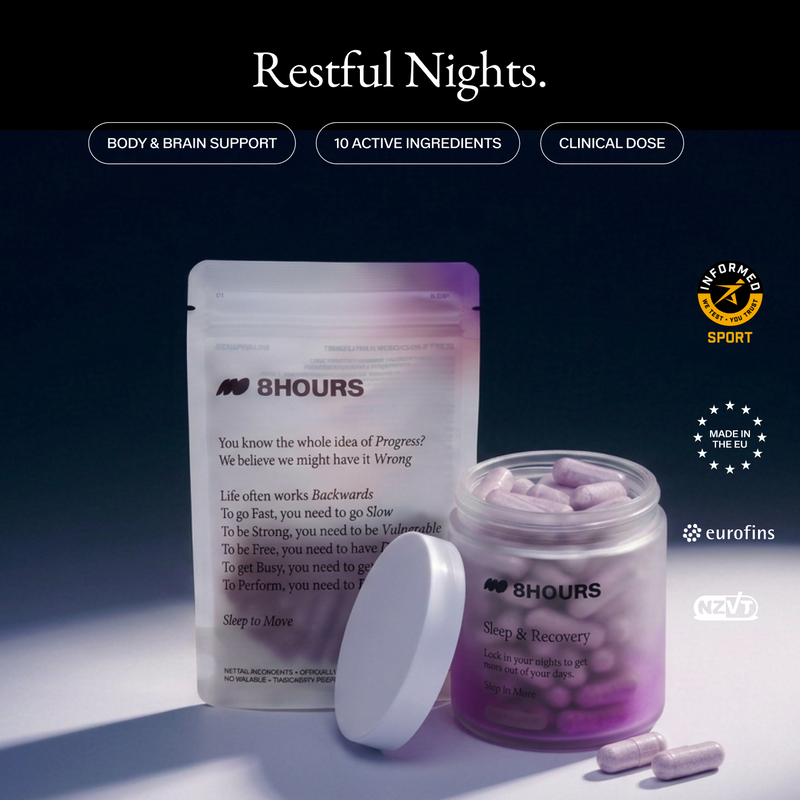
8hours Sleep & Recovery supports the quality of sleep you have already scheduled. It is not a treatment for ADHD, it will not shift a delayed circadian phase, and it does nothing about sleep-disordered breathing. Anyone selling you a supplement as an alternative to an assessment is selling you a delay.
If your last dose is at four in the afternoon, do not buy our capsules. Book the review. If your wake time moves by three hours across a week, do not buy our capsules. Anchor the mornings. If you snore and wake exhausted, do not buy our capsules. Get the sleep study.
Nothing in this article is a reason to change or stop prescribed medication on your own. Stimulants are effective treatments for a real condition, and the point of this piece is that they work better on top of a night that has been protected rather than sacrificed.

Sleep loss produces the symptom list. ADHD produces the sleep loss. Nobody in the appointment is measuring which share is which.
Send this to someone who got diagnosed at 32 and still cannot fall asleep at 2am.
- Van Veen, M.M., Kooij, J.J.S., Boonstra, A.M., Gordijn, M.C.M. & Van Someren, E.J.W. (2010). Delayed circadian rhythm in adults with attention-deficit/hyperactivity disorder and chronic sleep-onset insomnia. Biological Psychiatry, 67(11).
- Kidwell, K.M., Van Dyk, T.R., Lundahl, A. & Nelson, T.D. (2015). Stimulant medications and sleep for youth with ADHD: a meta-analysis. Pediatrics, 136(6).
- Gruber, R., Cassoff, J., Frenette, S., Wiebe, S. & Carrier, J. (2012). Impact of sleep extension and restriction on children's emotional lability and impulsivity. Pediatrics, 130(5).
- Van der Heijden, K.B., Smits, M.G., Van Someren, E.J.W., Ridderinkhof, K.R. & Gunning, W.B. (2007). Effect of melatonin on sleep, behavior, and cognition in ADHD and chronic sleep-onset insomnia. Journal of the American Academy of Child & Adolescent Psychiatry, 46(2).