Sleep debt is cumulative. So is sleep surplus. The week before a hard event is the part you can actually control.
Runners overfill glycogen stores for days before a marathon and nobody questions it. The race burns fuel faster than you can replace it mid-effort, so you load the substrate in advance and accept a slightly heavy week beforehand.
Sleep behaves the same way. Almost nobody treats it that way.
The night before a race, a final, an exam or a launch will usually be poor. You know this already. What most people miss is that the week in front of it is where the outcome gets decided, and that a surplus built in advance changes how far you fall.

Sleep debt is cumulative.
So is sleep surplus.
Hans Van Dongen and colleagues restricted 48 people for two weeks in 2003. The group held to six hours a night accumulated cognitive deficits equivalent to going two full nights without sleep at all. The part that should worry you is what those people reported about themselves. Subjective sleepiness levelled off after a few days while objective performance kept sliding. They felt stable. They were not.
Cheri Mah's group at Stanford took eleven varsity basketball players, established a baseline over two to four weeks, then had them extend time in bed to at least ten hours a night for five to seven weeks. Sprint times dropped. Free-throw and three-point accuracy rose by roughly nine percent. Reaction time improved and self-reported fatigue fell.
Eleven players, no control group. Some of that gain is probably ordinary in-season improvement, and anyone citing the study as proof of a nine percent shooting boost is overselling it. The direction holds up against the wider literature. The size of the effect does not.

The study that answers the actual question came out of the Walter Reed Army Institute of Research in 2009. Tracy Rupp and colleagues gave one group a week of extended sleep and left another on its habitual schedule, then cut both to three hours a night. The extended group performed better throughout the restriction and recovered faster once normal sleep resumed. Pierrick Arnal and a French military research team reproduced the pattern in 2015.
That is the whole argument. A surplus built beforehand raises the floor you fall to.
The mechanism
Adenosine builds up in the brain across the waking day and binds to receptors that generate sleep pressure. Caffeine works by blocking those receptors, which is why coffee hides fatigue without removing it. Sleep is when adenosine actually clears. Sleep too little and you start each morning with some left over, and that residue climbs across a restricted week. Extended sleep clears it and gives you headroom to spend.
The second explanation is shakier. Deep sleep loads into the first half of the night, and a long-standing hypothesis holds that slow-wave sleep replenishes glycogen stores in glial cells, refuelling the brain's local energy supply. The evidence is mixed and we would not build a claim on it. The behavioural findings stand whether or not this turns out to be the right account.
What banking does not do is let you skip sleep later for free. You still decline under restriction. You decline from higher up, and you climb back faster.

“Athletes prepare fuel, hydration and taper with real precision, then treat the sleep in the ten days beforehand as whatever happens to happen. It is the one variable with a demonstrable effect on the performance floor that most people leave entirely unmanaged.”

The night before is not where this is decided
Sympathetic arousal is high, the alarm is early, the bed is often unfamiliar, and trying to fall asleep on command raises arousal rather than lowering it. Effort makes it worse.
One bad night before a well-prepared event costs you less than most people fear. It costs far less than a badly slept fortnight. That is the part worth working on. Your job on the night itself is to have already made it not matter very much.
How to bank sleep
Identify the window one to two weeks out
Race, event, exam, launch week, a long-haul travel block, the fortnight after a baby arrives. You almost always know these are coming. Banking has to be scheduled, because it will not happen by accident.
Target one to two hours above your normal window
That is the dose the research used. Thirty minutes will not do much. Four extra hours will give you time awake in bed and a worse relationship with your bedroom.
Go to bed earlier instead of staying in bed later
Slow-wave sleep loads into the early cycles and REM dominates the later ones. Extending at the front of the night adds deep sleep preferentially. Extending at the back adds REM. Both have value. For physical recovery, earlier wins, and it keeps your wake time and circadian anchoring intact.
Quality decides what the extra hours are worth
Fragmented extra hours are worth far less than consolidated ones. Keep the room cool, because core temperature has to fall for sleep onset and depth. Skip alcohol during the banking window. It shortens sleep onset, then fragments the second half of the night and suppresses REM, so your surplus becomes time in bed.
Accept the hard night when it comes
You are making the drop smaller. You are not removing it. Going into the event knowing there is a surplus behind you takes away much of the anxiety that makes the final night worse, which is part of the benefit.
A 30-second decision rule
- Is there a defined high-demand window in the next one to two weeks?
- Do you expect your sleep to be restricted or disrupted during it, through travel, early starts, nerves or workload?
- Do you have five to seven nights in which you can realistically extend?
We sell a sleep supplement.
Here is what it cannot do.
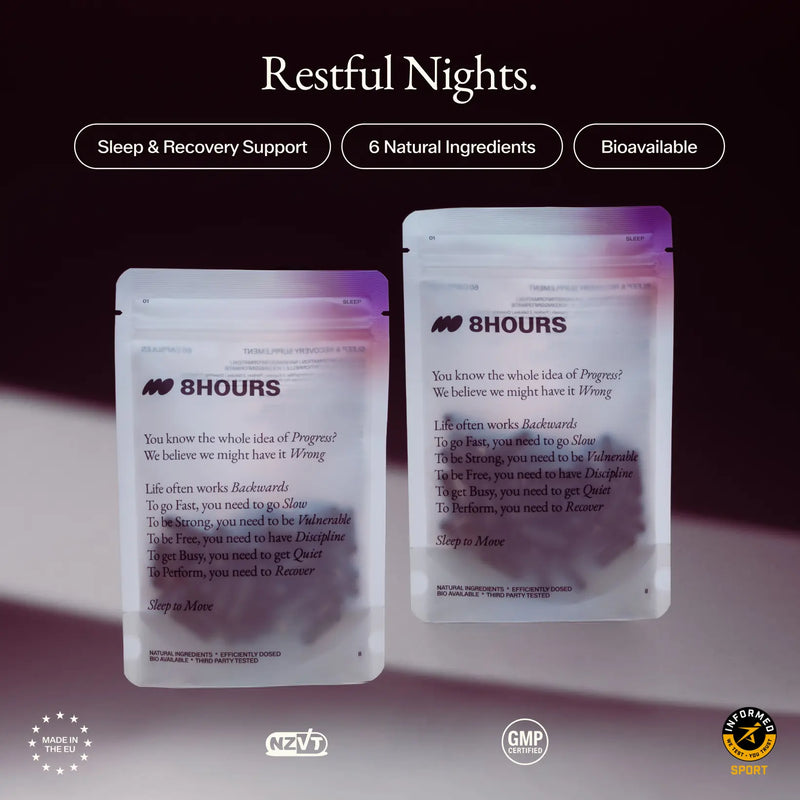
We make 8hours Sleep & Recovery and we are confident in the formulation. It supports the quality and consolidation of the sleep you actually schedule. It does not manufacture sleep you never went to bed for. Take it at midnight, rise at six, and you have improved the texture of six hours. You have banked nothing.
The supplement helps with item four. Items one, two and three are decisions about your calendar, and no capsule substitutes for them.
That is the less convenient version of the pitch. It is also the accurate one, and the athletes who get the most out of this are the ones who treated the schedule as the intervention and the product as support for it.

Carb-loading works because you prepare the substrate in advance. Sleep works the same way.
Send this to that friend who carb-loads for five weeks and averages six hours of sleep.
- Mah, C.D. et al. (2011). The effects of sleep extension on the athletic performance of collegiate basketball players. Sleep.
- Rupp, T.L., Wesensten, N.J., Bliese, P.D. & Balkin, T.J. (2009). Banking sleep: realization of benefits during subsequent sleep restriction and recovery. Sleep.
- Arnal, P.J. et al. (2015). Benefits of sleep extension on sustained attention and sleep pressure before and during total sleep deprivation and recovery. Sleep.
- Van Dongen, H.P.A. et al. (2003). The cumulative cost of additional wakefulness: dose-response effects on neurobehavioral functions and sleep physiology from chronic sleep restriction and total sleep deprivation. Sleep.