Ten young men, five hours a night for a week, ten to fifteen percent less daytime testosterone. The mechanism runs through lost sleep, not through the screen, and that distinction changes what you do about it.
Rachel Leproult and Eve Van Cauter published the trial in JAMA in 2011. Ten healthy young men, average age twenty four, spent one week in a laboratory restricted to five hours in bed. Daytime testosterone fell by ten to fifteen percent compared with their own rested baseline, and the men reported lower vigour as the week went on.
The comparison that made it famous is theirs: testosterone declines roughly one to two percent a year with normal ageing, so a week of short sleep produced a drop of a similar size to ten to fifteen years of age. That framing is a useful way to feel the magnitude, and it is a comparison of one hormone in ten men over one week, not a statement that you have aged.

Testosterone is made
on a sleep schedule
Testosterone in men follows a daily rhythm with a clear peak in the early morning and a trough in the late afternoon or evening. That rhythm is not driven by the clock on the wall. It is driven by sleep.
The rise begins at sleep onset, climbs through the night and peaks around the time of the first REM episode, roughly three hours in. Peter Luboshitzky and colleagues showed the dependency directly: fragmenting sleep in young men, particularly disrupting the first REM period, blunted the nocturnal testosterone rise. Sleep gates the hormone, and the first half of the night does most of the work.
The carousel says testosterone is produced specifically during deep sleep and REM cycles. Close, and worth sharpening. The rise tracks sleep onset and consolidated sleep, with the peak occurring around the first REM episode. It is not that particular stages manufacture the hormone; it is that continuous, uninterrupted sleep is required for the rise to complete. Fragmented eight hours is not the same as eight hours.
Which explains why a late bedtime against a fixed wake time is the expensive kind of short sleep. Cut an hour off the front and you remove part of the window in which the hormone climbs. Cut it off the back and you lose less.

What blue light does,
and what it does not
Blue light suppresses melatonin. That part is solid. Melanopsin-containing retinal cells are most sensitive to wavelengths around 460 to 480 nanometres, they signal the suprachiasmatic nucleus, and evening exposure both suppresses melatonin and delays the circadian phase. Anne-Marie Chang and colleagues at Harvard showed in 2015 that reading on a light-emitting device before bed suppressed melatonin, delayed sleep onset, reduced next-morning alertness and shifted the circadian clock relative to reading a printed book.
Two things that study did not find, and neither has anyone else, cleanly. It did not measure testosterone. And it did not establish that light from a phone at normal viewing distance is a large exposure compared with a bright room.
Phone at night, later bedtime, shorter and more fragmented sleep, lower testosterone. Every link is supported. What is not supported is a direct effect of screen light on testosterone independent of sleep. Nobody has shown that, and the piece does not need it: the sleep route is large enough on its own.
There is also a behavioural component people skip past because the light story is tidier. Content is engaging by design. The reason you are still on the phone at half past midnight is usually not photons, it is the feed. Studies that dim or filter screen light without changing usage tend to find smaller effects than studies that change when people stop using the device.
Two more findings worth carrying. Sleep apnoea lowers testosterone substantially and independently of duration, through fragmentation and intermittent hypoxia, and it is underdiagnosed in exactly the men who read articles like this one. And the Leproult effect is reversible. Testosterone recovered when the men returned to normal sleep, which is the most encouraging sentence in the whole literature.

“Men will spend four hundred pounds on a testosterone panel and then go to bed at one in the morning with the phone on their chest. The panel is a photograph of a variable they are actively suppressing. Sleep for two weeks first, then test.”

Four things, in order
of how much they matter
No phone 60 to 90 minutes before bed
The light matters and the content matters more. This is the item that actually moves your bedtime earlier, which is the variable the Leproult trial manipulated. Night mode and blue-light filters help at the margin and do not address the reason you are still awake. Put the device in another room, because willpower at midnight is not a plan.
A consistent sleep window, protected at the front
The nocturnal rise runs from sleep onset and peaks around three hours in, so the first half of the night is where the hormone is made. A late bedtime against a fixed wake time removes the expensive part. Regularity also stabilises the circadian rhythm that the whole pattern sits on.
Dim the lights after sunset, get daylight in the morning
Evening light delays the clock and morning light advances it, and outdoor morning light is far brighter than anything indoors. Overhead lighting after nine is a larger exposure than most people assume. This is circadian maintenance rather than a direct hormonal intervention, and it is what makes the earlier bedtime achievable.
Rule out apnoea before you test anything
Obstructive sleep apnoea lowers testosterone through fragmentation and intermittent hypoxia, and it does so independently of how long you are in bed. Loud snoring, witnessed pauses, waking unrefreshed after eight hours or heavy daytime sleepiness are reasons for a sleep study, not for a supplement. This is the one item that can change a diagnosis.
A 30-second decision rule
- Over the last month, have you averaged under seven hours of sleep on most nights?
- Is your phone in your hand within thirty minutes of falling asleep?
- Do you snore heavily or wake unrefreshed after a long night?

We sell magnesium and glycine.
Neither raises testosterone.
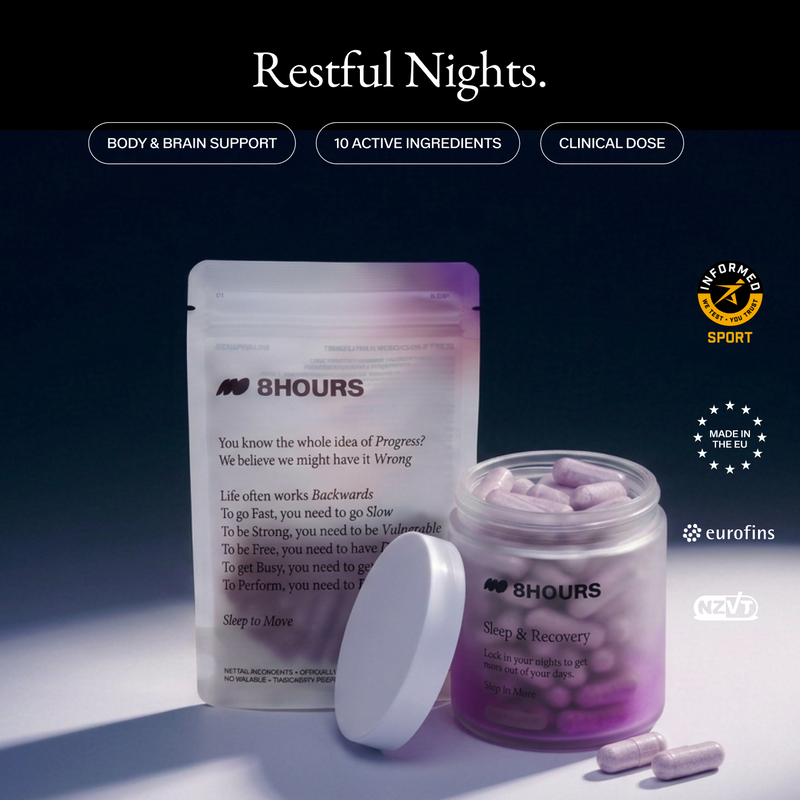
8hours Sleep & Recovery supports the quality and consolidation of sleep you have already scheduled. It does not raise testosterone, no trial has tested it against a hormone panel, and if anyone in this category tells you their capsule is a T booster, read the trial they are citing before you read the label.
If your phone is in bed with you, do not buy our capsules. Move the phone, because that is the item that shifts your bedtime. If you go to bed at one and get up at six thirty, do not buy our capsules. Add the hours. If you snore and wake exhausted, do not buy our capsules. Get the sleep study.
The good news in this article is free. The Leproult men recovered when they slept normally again, and the intervention that produced the fall was a week of short nights rather than anything permanent. Nothing we sell competes with that, and we are not going to pretend it does.

Testosterone optimisation starts in the bedroom, not the gym. The phone is not doing anything to your hormones. It is taking the hours in which they are made.
Send this to the guy getting castrated in bed right now.
- Leproult, R. & Van Cauter, E. (2011). Effect of 1 week of sleep restriction on testosterone levels in young healthy men. JAMA, 305(21).
- Chang, A.-M., Aeschbach, D., Duffy, J.F. & Czeisler, C.A. (2015). Evening use of light-emitting eReaders negatively affects sleep, circadian timing, and next-morning alertness. PNAS, 112(4).
- Luboshitzky, R., Zabari, Z., Shen-Orr, Z., Herer, P. & Lavie, P. (2001). Disruption of the nocturnal testosterone rhythm by sleep fragmentation in normal men. Journal of Clinical Endocrinology & Metabolism, 86(3).
- Wittert, G. (2014). The relationship between sleep disorders and testosterone in men. Asian Journal of Andrology, 16(2).